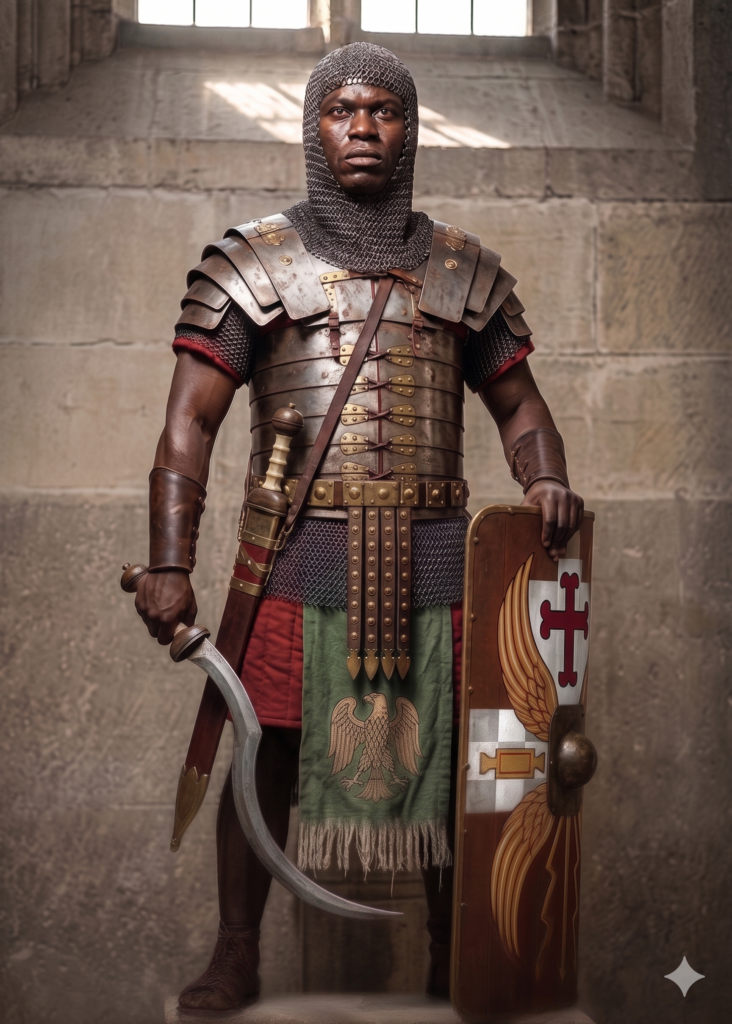
Saint Maurice — Brief Bio
Saint Maurice was a 3rd‑century African military leader from Thebes in Upper Egypt, renowned as the commander of the Theban Legion, an elite unit of Christian soldiers serving under the Roman Empire. Around AD 286, Maurice and his legion were ordered by Emperor Maximian to persecute fellow Christians. They refused, choosing fidelity to Christ over imperial command. Their collective martyrdom at Agaunum (modern‑day Saint-Maurice, Switzerland) became one of the most influential testimonies of early Christian courage.
Maurice’s legacy spread across Europe, where he became the patron saint of soldiers, knights, and the Holy Roman Empire. His depiction in medieval art—especially the Magdeburg Cathedral statue, one of the earliest realistic portrayals of an African saint in Europe—stands as a powerful witness to Africa’s foundational presence in Christian history.
Sovereign Heritage Statement
Saint Maurice embodies the truth that African identity and Christian identity are not competing realities but divinely woven strands of a single sovereign heritage. His life testifies that from the earliest centuries of the church, African believers stood at the center of God’s redemptive story, leading, teaching, defending the faith, and shaping global Christianity. Maurice’s witness affirms that Africa’s sons and daughters have always carried a royal, courageous, and God-ordained place in the unfolding of salvation history.